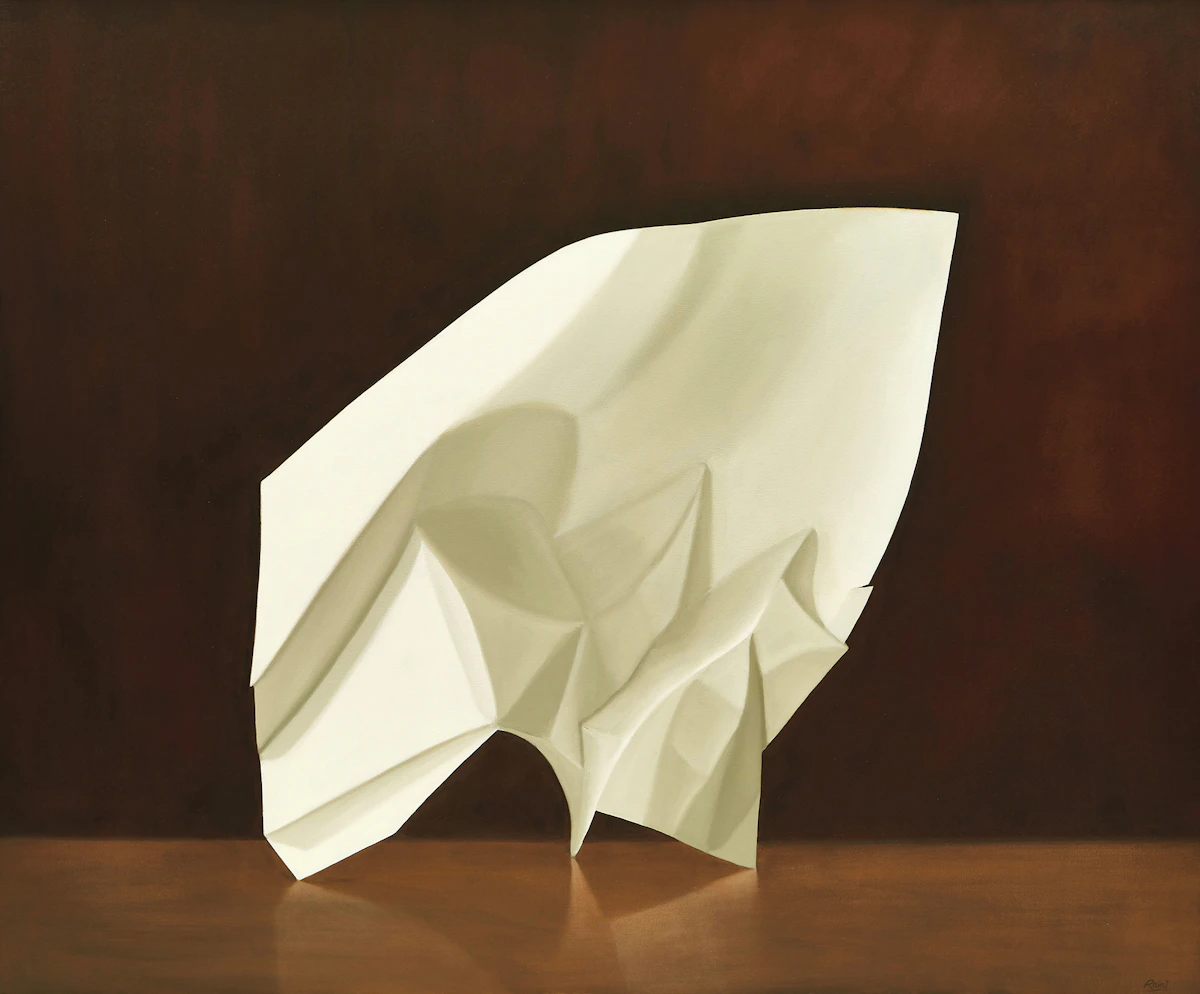
signed lower right; signed, titled and dated 2012 on the stretcher
44.75 × 53.75 in (113.7 × 136.5 cm)
Auction Estimate:$7,000 - $9,000
Sale date:May 28, 2019
Price Realized
$14,160
(including Buyer's Premium)
Provenance
Private Collection, Calgary
Literature
Donald Brackett, “Distilled Life: Art of the Recent Future by Malcolm Rains,” in Myth and Mystique: The Art of Malcolm Rains, exhibition catalogue (online), Odon Wagner Contemporary Gallery, Toronto, May 7-28, 2016
Characterized by their rich palettes and brilliant, precise lighting, Malcolm Rains’ canvases recall the restraint and elegance of Renaissance and Baroque memento mori and still life paintings, but with a distinctly contemporary approach to rendering his subjects as near-sculptural forms. A graduate of architectural studies at the University of Detroit Mercy and the University of Toronto, Rains also received a rigorous training in conceptual art at the Ontario College of Art in the early 1970s, where he concentrated on sculpture. Restrained and monumental in scale and subject, the artist’s works reflect a keen sense of the internal order within seemingly mundane objects, imparting grace and structure to such prosaic forms as paper towel rolls and crumpled sheets of paper. The artist credits Juan Sanchez-Cotan, a 17th-century Spanish painter of austere, almost minimal still lifes, as a major influence on his own painting practice.
Often working in series to explore the full potential of a particular subject, Rains strips away unnecessary visual information, preferring to emphasize stark tonal contrasts and the interplay of light and shadow within his pared-down compositions. Though the results of careful observational study, the resulting images are immediately striking for what the artist chooses to omit. Furthering the sense of mystery are the classical Greek and pre-Hellenic titles which Rains gives to his canvases. As Donald Brackett writes, names like “Kyriamadi” reference place names important in antiquity (and by extension, the civilization inherited in the West), as well as the artist’s interest in pre-Socratic philosophies on the origins of matter, and in classical notions of beauty, order, and proportion. “These paper structures could either be immensely huge or infinitely tiny, or both at once. As such, they are quantum paintings par excellence and each could be considered a macroscope, a tool for accessing the gigantic grandeur of distilled life. Exactitude is their chief attribute, both in form and content.”