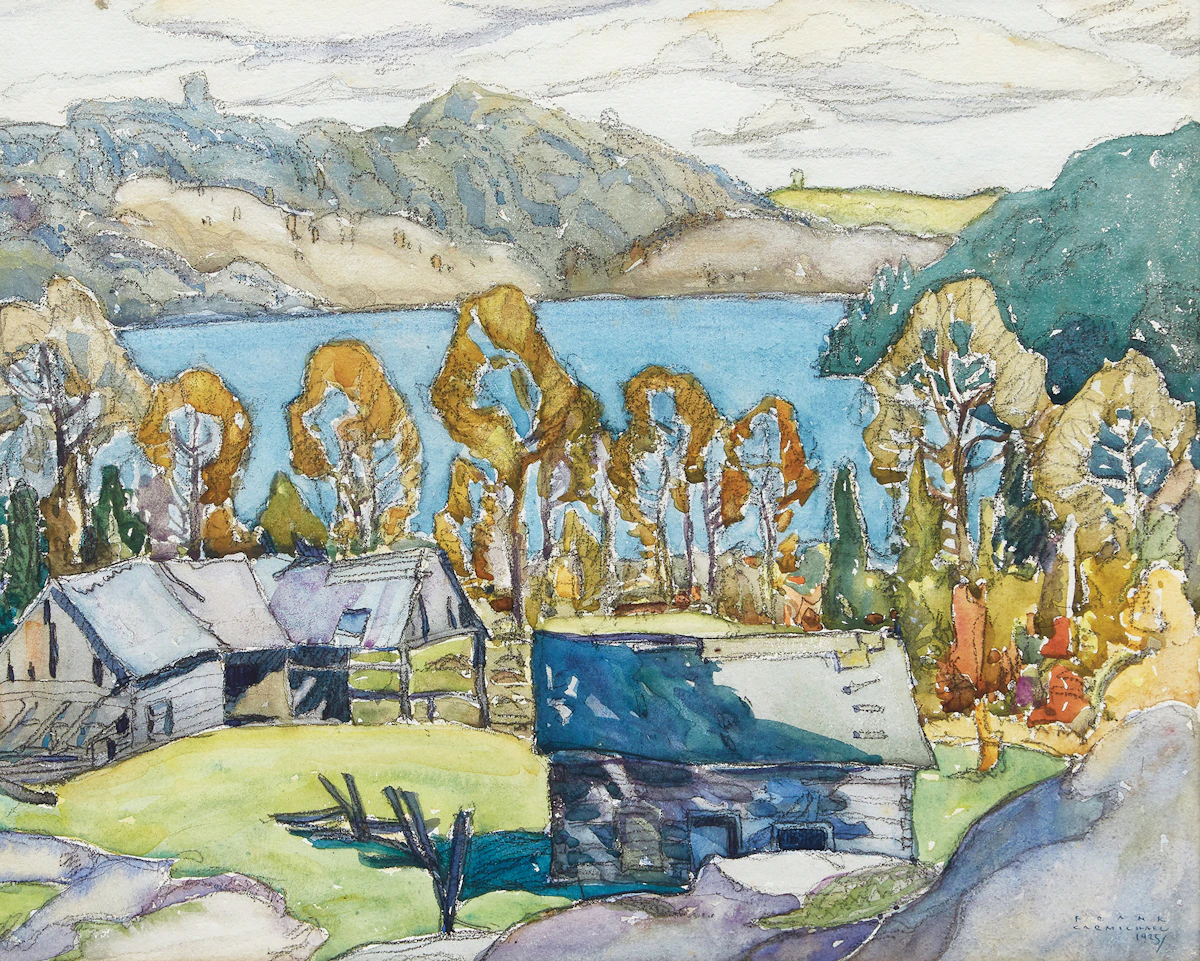
signed and dated 1925 lower right; signed and titled on the reverse of the framing
10 × 12.5 in (25.4 × 31.8 cm) (sight)
Auction Estimate:$30,000 - $40,000
Sale date:May 28, 2019
Price Realized
$23,600
(including Buyer's Premium)
Provenance
Private Collection, California
By descent to the present Private Collection, Toronto
Literature
Megan Bice, Light and Shadow, The Work of Franklin Carmichael, McMichael Canadian Art Collection, Kleinburg, pages 37, 39, 55, 65, 85 and 105
Joan Murray, Rocks: Franklin Carmichael, Arthur Lismer, and the Group of Seven, Toronto, page 17
In 1924, Carmichael had returned to his practice in watercolour after working primarily in oil paint with his fellow Group of Seven members. Favoured as the medium of choice to capture the rich rugged quality of the Canadian landscape, oil paint was considered the only ‘suitable’ medium in the landscape genre, however Carmichael was a master of watercolour and returned to his passion in pursuit of new frontiers.
Favouring rich colour and design, the artist captured the landscape with exaggerated form to accentuate the drama of the relationship between man and his natural surroundings. “Old Barns, Miner’s Bay” is an early and important work of Carmichael’s career as it typifies his response to his surroundings, emphasizing the emotional and sensory aspects of the scene around him. Depicted from a higher vantage point perched in a cluster of rocks, Carmichael evokes a feeling of the sublime as the viewer gazes above the old barn structures, patterned with dark shadows, and beyond to the bay, framed by layered hills. Bolds pops of cerulean, indigo and emerald speckle the scene of rural barns and expansive land dotted with autumnal trees. Strong contour lines enhance the character and mood of the scene, all design elements honed by the artist’s time as a graphic designer in Toronto.
Carmichael was deeply interested in the study of light as it was refracted by the cloud formations and reflected by the land and water beneath and sought to “present the interdependent relationships of the world he saw illuminated around him—order and tangle, delicacy and mass, man and nature.” The background bay and sky occupies nearly two thirds of the compositional layout, a strategy the artist often gravitated towards. The eye first rests on the foreground barns before naturally moving past the structures to settle on the grand vista beyond. A master of capturing the sublime with the delicacy of watercolour, Carmichael achieves a distinct drama in this work.