Collection of Leo Katz
Private Collection, Toronto
Literature
Christine Boyanoski, “Charles Comfort's 'Lake Superior Village' and the 'Great Lakes Exhibition 1938-39',” Journal of Canadian Art History/ Annales d'histoire d'art canadien, Volume 12, Number 2, 1989, page 186
Best known for ordered landscapes utilizing earthy tones to emote a moody stillness in his composition, Charles Comfort's relationship with members of the Group of Seven helped influence and solidify his position as a documentarian of the Canadian landscape.
Working for Brigden's Limited in Winnipeg, Comfort was transferred to the Toronto branch of the graphic design firm in 1925. The artist then joined the Arts and Letters Club, Toronto, and began taking art classes where he continued to meet and socialize with members of the Group and their compatriots. In 1936, Comfort obtained a studio space next to A.Y. Jackson in the Studio Building where the influence of the artist's work can be seen in Comfort's development as an artist. Similar use of rich ribbons of pigments to delineate strong form with progressive cobalts and rust hues are seen in his gestural application of oil paints, akin to Jackson.
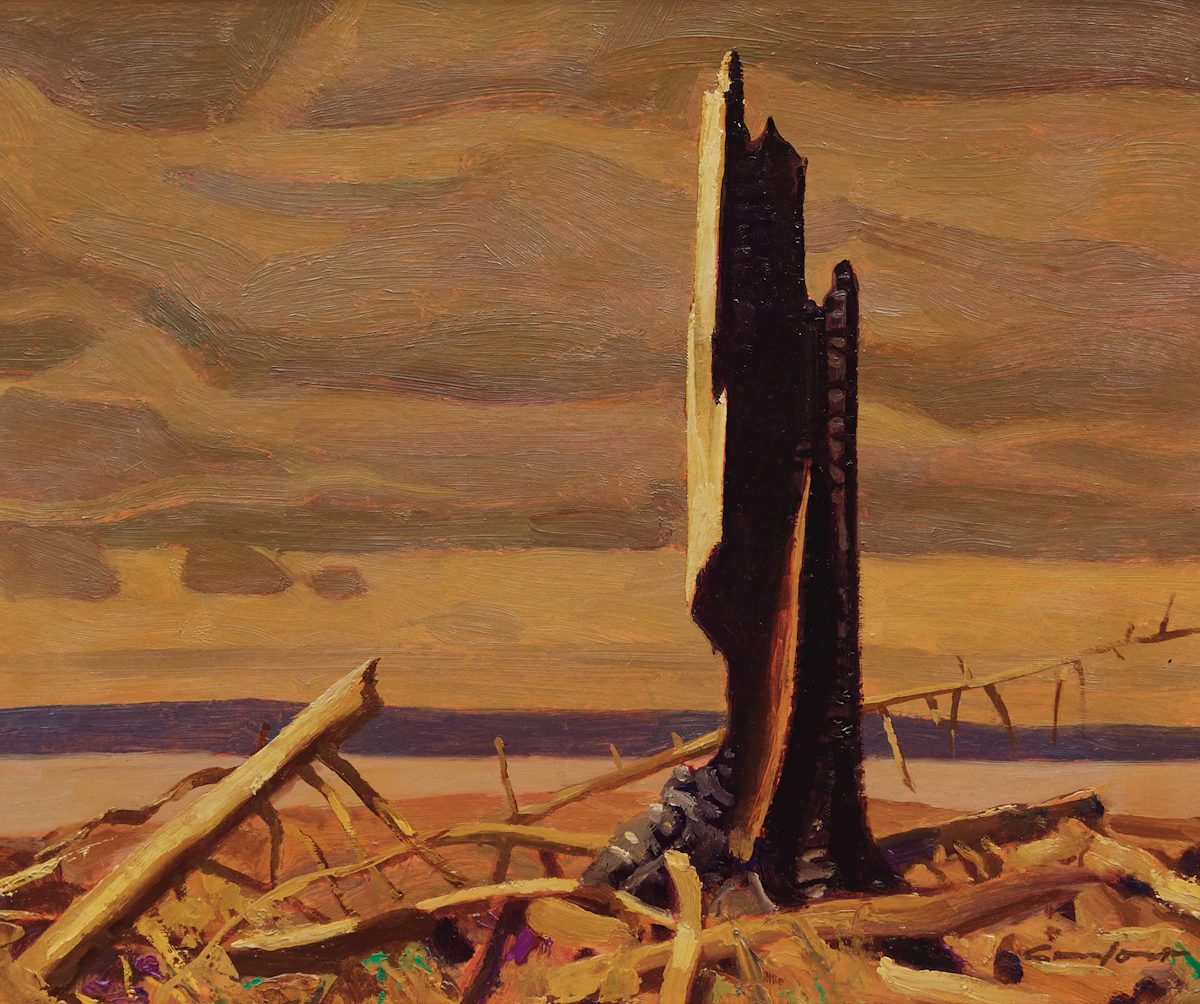
“Copper Island, Lake of the Woods” is a token of the artist's painting trips with both Lawren Harris and A.Y. Jackson to the lower region of Lake of the Woods on an Island near Lake Superior. In the area of Rossport, Ontario, Copper Island offered Comfort the scale and strength of the landscape that he had sought to portray. With a variety of vistas, both barren and rich in varied topography, the unique location was a “sort of last great line of defence protecting the invisible secrets of the north.” The viewer can certainly see the similarities in Comfort's work as in Harris's own representation of the barren tree-lined shores of Lake Superior. The simplified and graphic composition accentuates the grandness of the natural relic—the central tree stump— in the glowing haze of the rural locale.