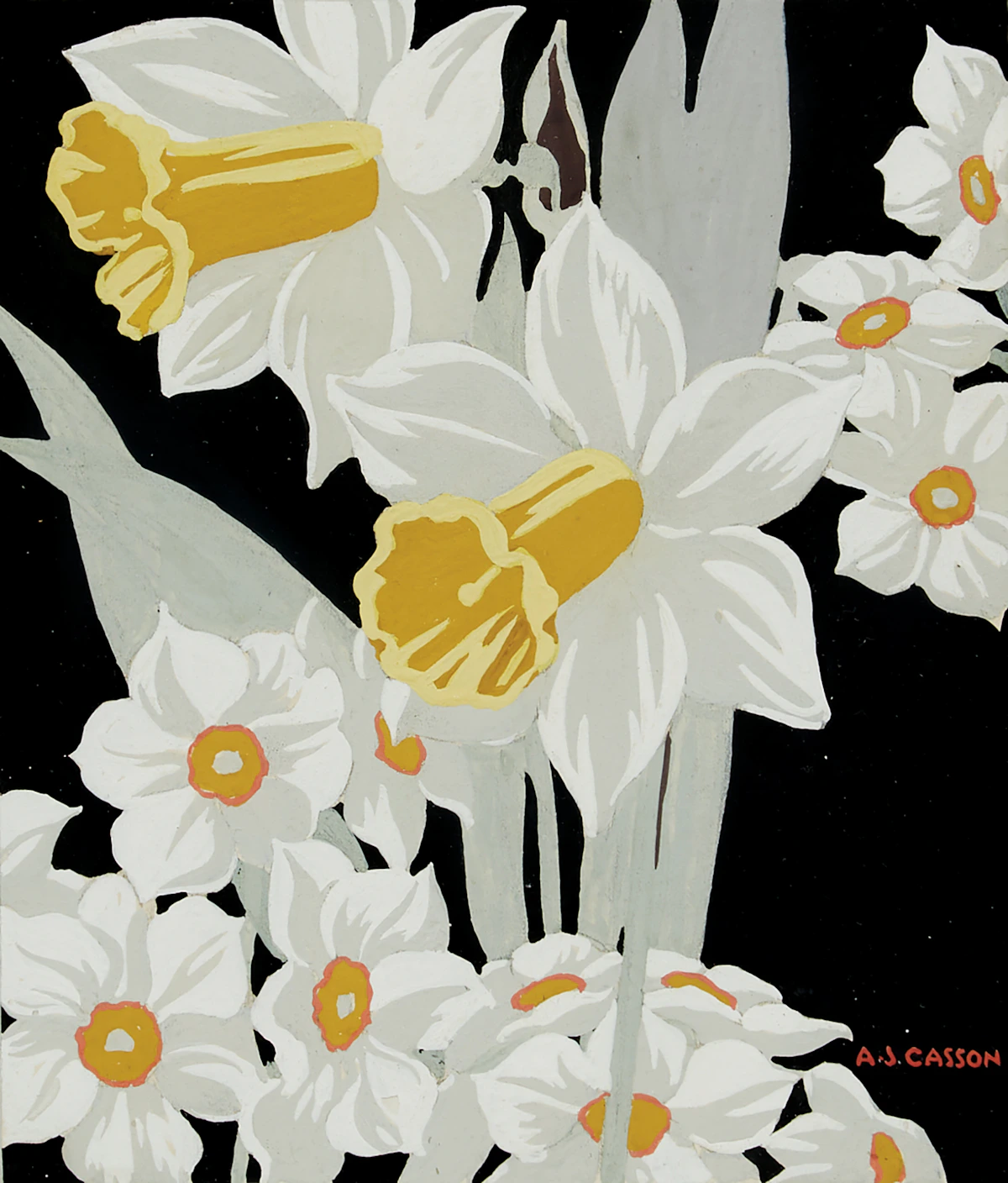
signed lower right; signed and dated 1927 on a label on the reverse
7.25 × 6.25 in (18.4 × 15.9 cm) (card)
Auction Estimate:$3,000 - $5,000
Sale date:November 20, 2018
Price Realized
$8,260
(including Buyer's Premium)
Provenance
Sobot Gallery, Toronto
Collection of Leon Katz
Private Collection, Toronto
Literature
Casson, A.J, “The Possibilities of Silk Screen Reproduction,” Canadian Art, Volume 7, Number 1, 1949, pages 12-14
Casson began his career like many other members of the Group of Seven, as a graphic designer. First apprenticing at the Laidlaw Lithography Company in Hamilton, he later joined Franklin Carmichael at the design firm of Rous and Mann and later accompanied Carmichael to the design firm of Sampson-Matthews.
While preparing for the silk screen process, Casson worked with up to 15 colours in preparatory drafts and was careful to select imagery and colours that could easily be reproduced without losing the integrity of the original composition. Forms were simplified but designed so colours could easily be seen at a distance, maintaining strong contrast and vibrancy.
For the artist, the silkscreen process was not simply a means to commercially mass produce. Rather, the artist respected the labour-intensive process and was a champion for the medium to be tested and recognized as a distinct and high art form. He argued that it's use in commercial art in the 1930s tainted the art form as a respected art practice and maintained that artists should continue to explore the medium's possibilities in fine art.