The Art Emporium, Vancouver
Private Collection, Toronto
Literature
Hubert De Santana, “A Painter’s Life: A.J. Casson looks back on 60 years at the easel,” Canadian Art, Spring 1985, pages 64-69
Paul Duval, A.J. Casson, Toronto, 1951, unpaginated
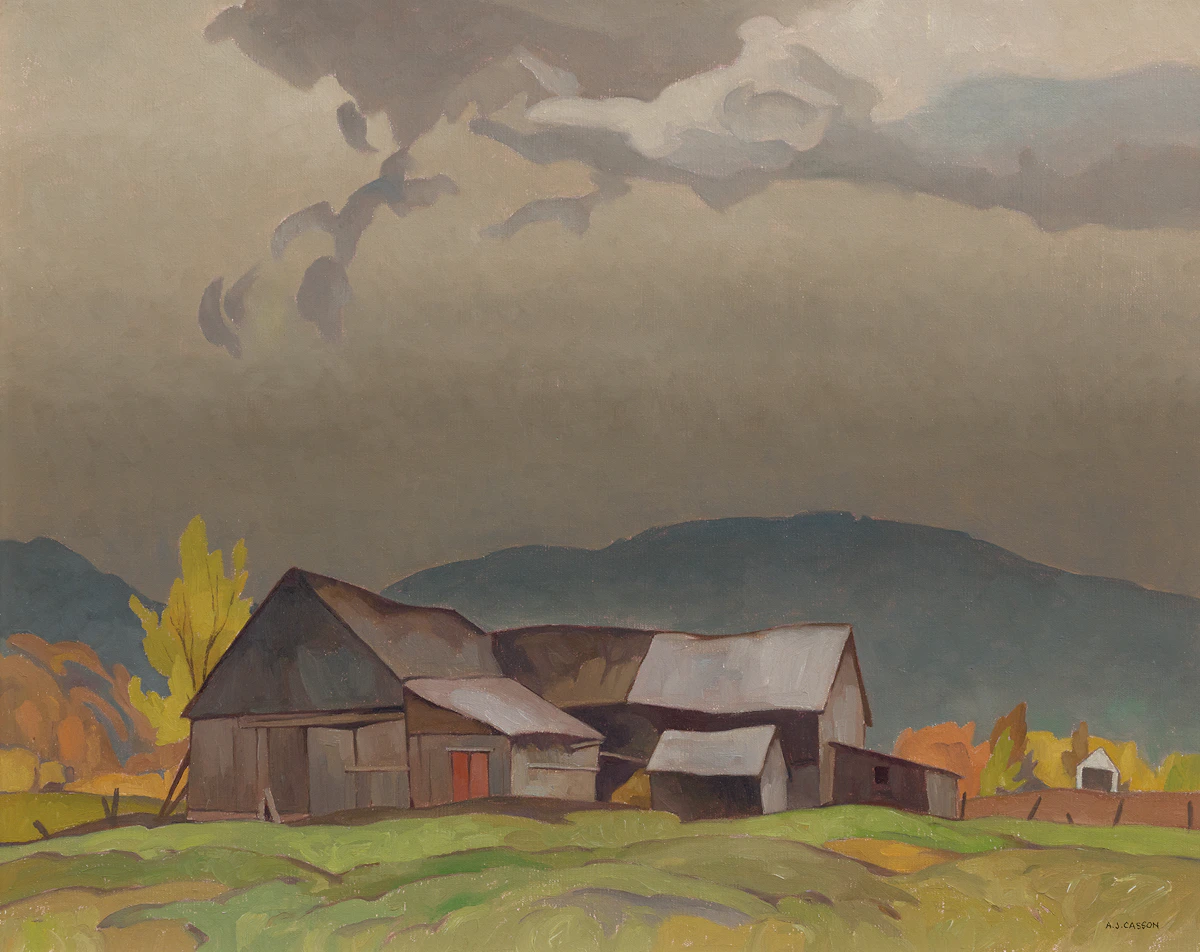
One of Canada’s master landscape painters, A.J. Casson was dedicated to Ontarian subject matter throughout his fruitful career. “Barns at Grenville, Quebec” was painted during one of Casson’s rarer ventures into another province; the municipality of Grenville is situated on the Ontario-Quebec border along the Ottawa River.
“Barns at Grenville, Quebec” captures a scene in transition. While the green fields in the foreground suggest the ripe lawns of summer, the trees’ stark yellows and oranges suggest the change in season. A.J. Casson’s landscapes of the mid-1940s began to incorporate a more dramatic lighting that is divided into planes across the surface of the composition. This work illustrates the recent shift, visible in the the angular lines in the barn roofs and simplified cloud formations. The oil on canvas painting, in its looming and heavy sky, exudes the feeling of the last moments of calmness in anticipation of an impending storm.
Common to Casson’s work throughout his career is a limited colour palette. In a 1985 interview, the artist recalls this strategy as being present since his early days with the Group of Seven, when “exhibitions were flaming with colour.” He elaborated by stating: “Well, I’ve always thought that if you want to stand out, don’t follow the herd. I was inclined to go into subtle greys, to get away from the gaudy. I painted a few gaudy ones, but they never appealed to me.”
Speaking to Casson's village compositions, Paul Duval notes that, “even when no figures ornament their architecture, this Canadian artist's townscapes are pregnant with mood. Like the contemporary American realist, Edward Hopper, he has the ability to crystallize a moment, to make concrete and eternal the passing vision. It is as though the time-machine has suddenly ceased to function, in a world where the wind had stopped breathing and the shadows no longer moved and every blade of glass and cloud were fixed forever.”