Hugues de Jouvancourt, Cornelius Krieghoff, Toronto, 1973, reproduced page 82
J. Russell Harper, Krieghoff, Toronto, 1979, page 44
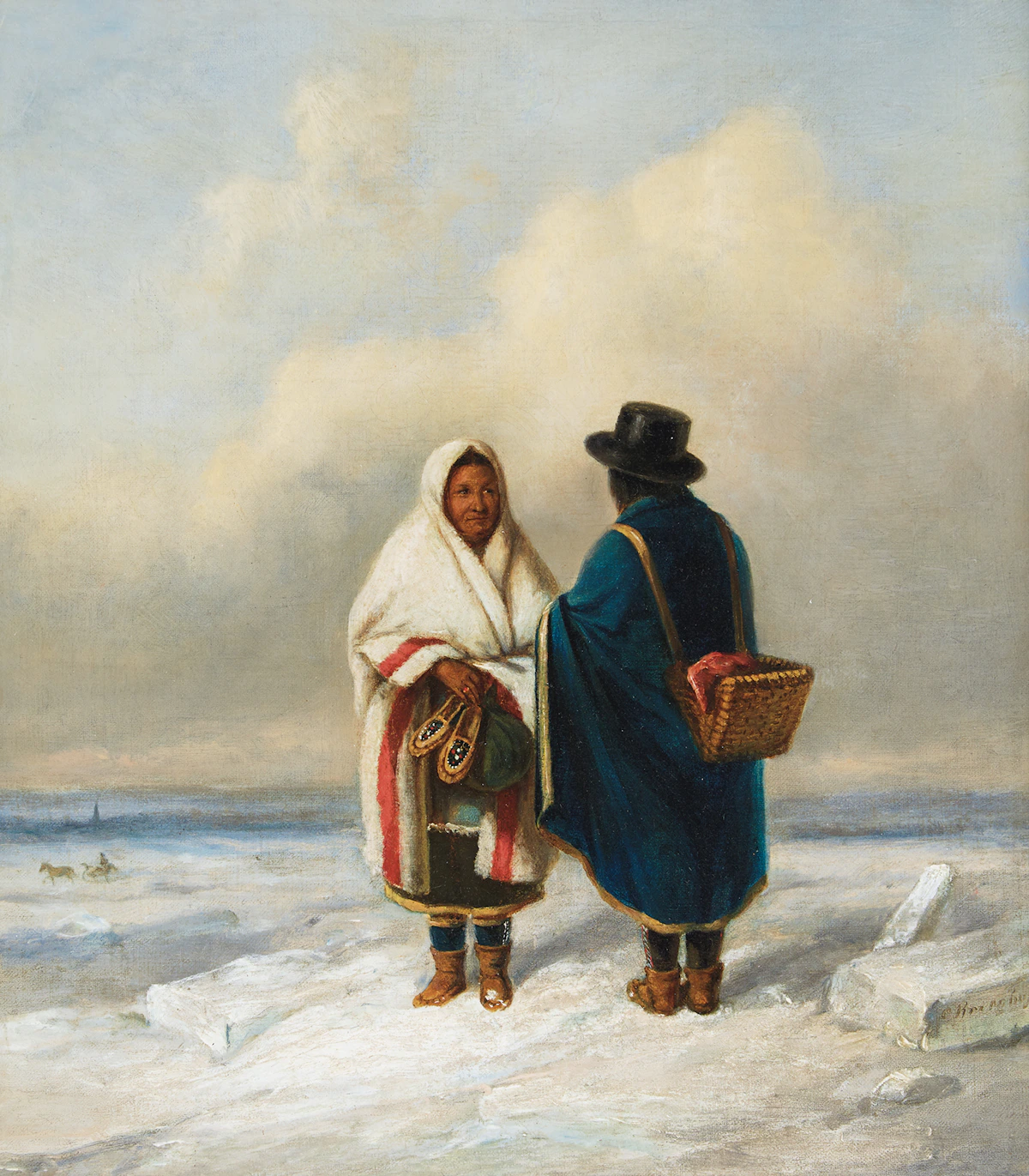
Depictions of the Native population make up approximately one-third of Krieghoff’s known body of work, and are some of his most acclaimed paintings. When Krieghoff settled in Montreal in 1846, he regularly painted the First Nations people of Caughnawaga, a Mohawk native reserve on the south shore of the island. In 1853 the artist moved to Quebec, and revisited this preferred subject throughout the city and its surrounding regions. John Russell Harper remarks on this recurring subject in Krieghoff’s paintings: “Some document the solitary moccasin or basket sellers who wandered the streets of Montreal and Quebec City in all seasons; others are of lonely hunters, gun on shoulder, plodding over snowy plains.” “Going to Market” depicts an encounter of two of these vendors on the snow-covered plains of the native reserve. One figure, wrapped in a blanket, clutches a pair of beaded moccasins and faces the other figure whose back is turned to the viewer.
Harper writes that Krieghoff’s use of a snowy landscape setting was intended to add an air of romance to the composition and to suggest a sense of exoticism of the Native people. The artist had little interest in painting these portraits as character studies of individuals with distinct feelings; rather, they served primarily as a symbol of “the native”, with minimal facial expression. In fact, Krieghoff used his wife Emilie as a model for both figures in this painting. The artist’s depictions of native figures, such as in “Going to Market” with only one face visible, serve essentially as mannequins for the display of exotic costumes. This approach relates to a similar practice widespread in European painting since the early 18th century that Krieghoff would have been familiar with.