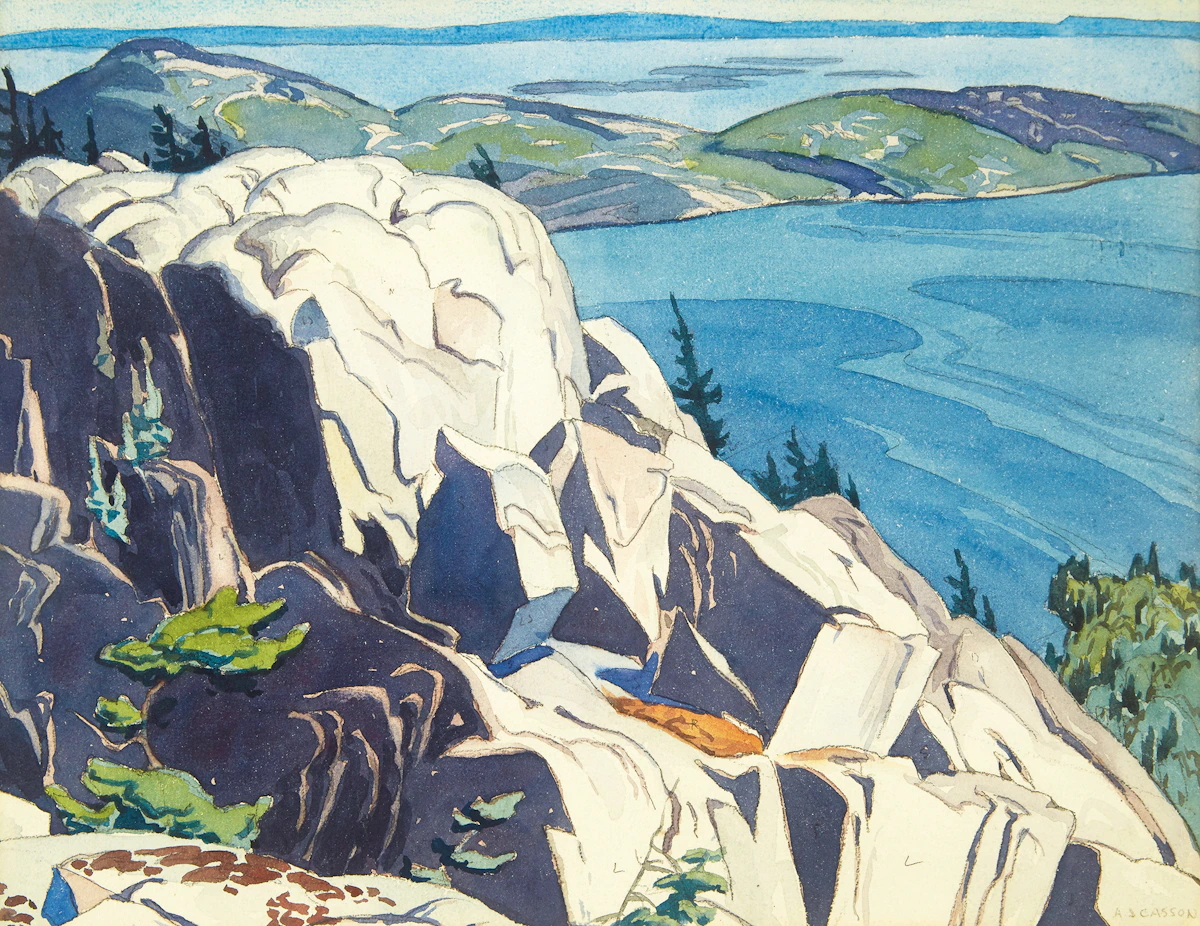
Fraser Bay from the Mustard Cut (Looking West on Baie Fine toward Fraser Bay)
watercolour
signed lower right and titled “Fraser Bay from the Mustard Cut”; also titled “Looking West on Baie Fine toward Fraser Bay” on the reverse of the framing
10.75 × 13.75 in (27.3 × 34.9 cm)
Auction Estimate:$25,000 - $35,000
Sale date:November 23, 2017
Price Realized
$23,000
(including Buyer's Premium)
Provenance
Acquired directly from the artist
Private Collection, Ontario
By descent to the present Private Collection, British Columbia
Literature
Paul Duval, A.J. Casson, Toronto, Roberts Gallery, 1975, page 109
Paul Duval, Alfred Joseph Casson, President, Royal Canadian Academy, Toronto, 1951, pages 14, 21 and 26
Paul Duval, Canadian Water Colour Painting, Toronto, 1954, unpaginated
Margaret Gray, Margaret Rand and Lois Steen, A.J. Casson: Canadian Artists 1, Ontario, 1976, page 6
Ian Thom, Casson's Cassons, Kleinburg, The McMichael Canadian Art Collection, 1988, pages 5 and 18
Located in Killarney Provincial Park, near Georgian Bay, Baie Fine offered Casson sublime sweeping vistas of lush landscape rich in forest and natural cliffs of quartzite rock and pink granite. Casson's limited cool palette of greens and blues suited this locale perfectly as he was able to render the vantage in watercolour with exacting precision. One can see the crisp graphic nature of Casson's style, influenced by his time as a graphic designer for the Grip and Rous and Mann in Toronto. With a nod to art nouveau aesthetics emphasizing the flattening of forms creating simplified patterns, the artist showcases the landscape’s opportunity to be viewed with clean, clear colours, articulating it’s grand potential.
On Casson's dedication to watercolours, Paul Duval writes that Casson “had become one of the most powerful and expressive watercolour painters Canada has ever known. His compositions had acquired a sure formalization, his washes were laid with a consummate assurance and the boldness of his colour revealed a brilliance and depth then rarely seen in the medium.” Deep purples accentuate shadow and imperfections in the rock formations while subtle washes of grey and faint yellow illuminate the rocks to the left of the composition. Ian Thom writes, “what also emerges with startling clarity is an exquisite, emotional tension. His ability to use composition, colour, light, technique and subject matter to create images of a preternatural, haunting stillness, maybe Casson's greatest achievement as a painter.”