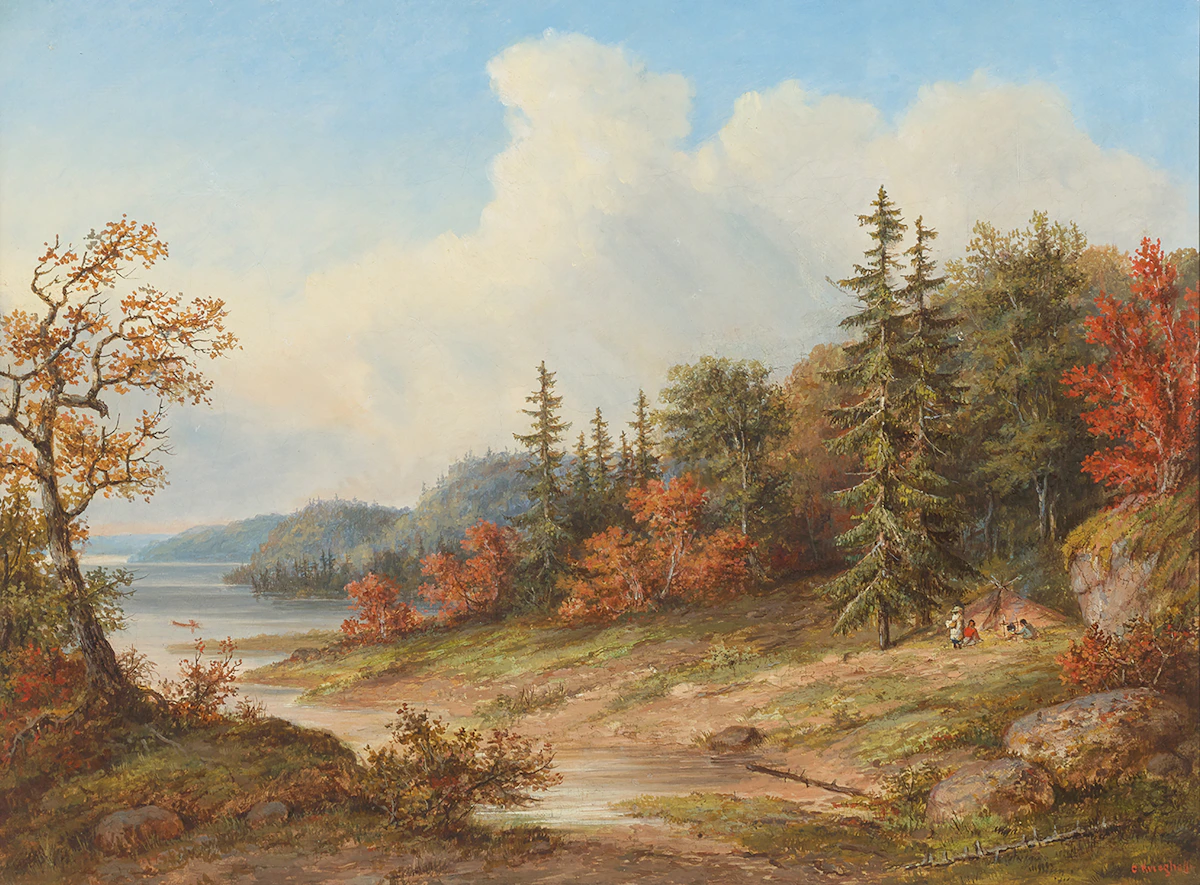
J. Russell Harper, Krieghoff, Toronto, 1979, pages 44 and 137
Cornelius Krieghoff’s images of Canada’s native people are some of his most acclaimed within a wide range of subject matter. Depictions of the native population make up approximately one-third of the artist’s known body of work. Krieghoff often represented this subject as a portrayal of an idealistic relationship between man and nature. In paintings such as “Indian Encampment on the Lower St. Lawrence,” he sought to represent the Native People as being perfectly attuned to nature. As Russell Harper notes, Krieghoff portrayed “man unspoiled by the complexities of artificial and unnatural civilization.” The canvas depicts a sumptuously detailed view of the St. Lawrence River in autumn, and only upon a closer look does it reveal three figures surrounding a wigwam. Harper writes that Krieghoff gradually scaled down the human presence in these works in order to emphasize the idyllic landscape, stating that “increasingly he viewed them romantically and at the same time, he shrank them into large landscapes.”
Krieghoff settled in Montreal in 1846, where he regularly painted the First Nations people of Caughnawaga, a Native reserve south of the island. He produced large canvases for wealthy clients and very small ones for those with modest incomes. In 1853 the artist moved to Quebec, and revisited this preferred subject throughout the city and its surrounding regions. While Canada was undergoing major constitutional changes in addition to industrialization and urbanization during Krieghoff’s two decades in the country, the artist rarely depicted evidence of this transformation in his artworks. Rather, he was firmly preoccupied with French-speaking ‘habitants’ and the Native People of rural life.