Ian M. Thom, E.J. Hughes, Vancouver Art Gallery, 2002, page 99
Jane Young, E.J. Hughes 1931 - 1982: A Retrospective Exhibition, Surrey Art Gallery, 1983, page 43
A native of Nanaimo and former student of the Vancouver School of Art, E.J. Hughes' work is celebrated for its depictions of the stunning wilderness of British Columbia. As art movements in Canada rapidly evolved into abstraction and minimalism, Hughes maintained a steadfast and unique dedication to realism throughout his long career. His distinct and nostalgic style consisted of flattened perspective and simplified forms. On the subject of the association between realist art and photography, the artist proclaimed: “If I didn’t have a conviction that a serious painter can portray Nature more profoundly than the best colour photography, I’d probably give it all up or go abstract or take up photography.”
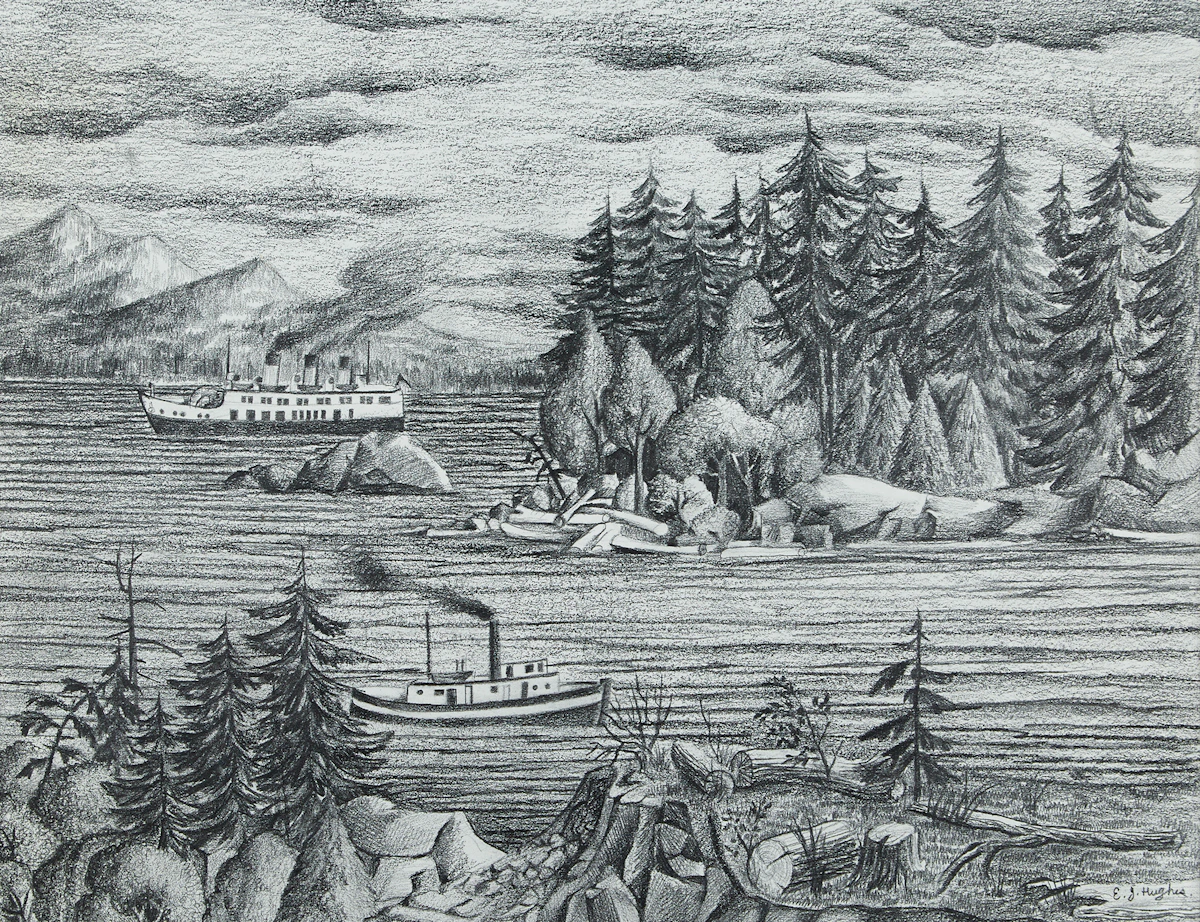
“Robson River” and “Sidney, B.C.” attest to Hughes' meticulous and painstaking approach to illustrating the landscapes of British Columbia. During the 1950s, the artist approached each painting through a series of drawings, beginning with intricately detailed notes outlining full reference for the picture's theme. Hughes normally completed a detailed graphite drawing known as the “cartoon”, which was then ruled off into squares in order for the composition to be transferred to the canvas. These cartoons, “in which the graphite is applied so heavily that the velvety blacks resemble those of a lithograph,” truly stand by themselves as finished artworks, as exemplified in “Robson River” and “Sidney B.C.”. Beginning in 1960, Hughes abandoned the cartoon in favour of a watercolour sketch, in order to speed up the procedure.