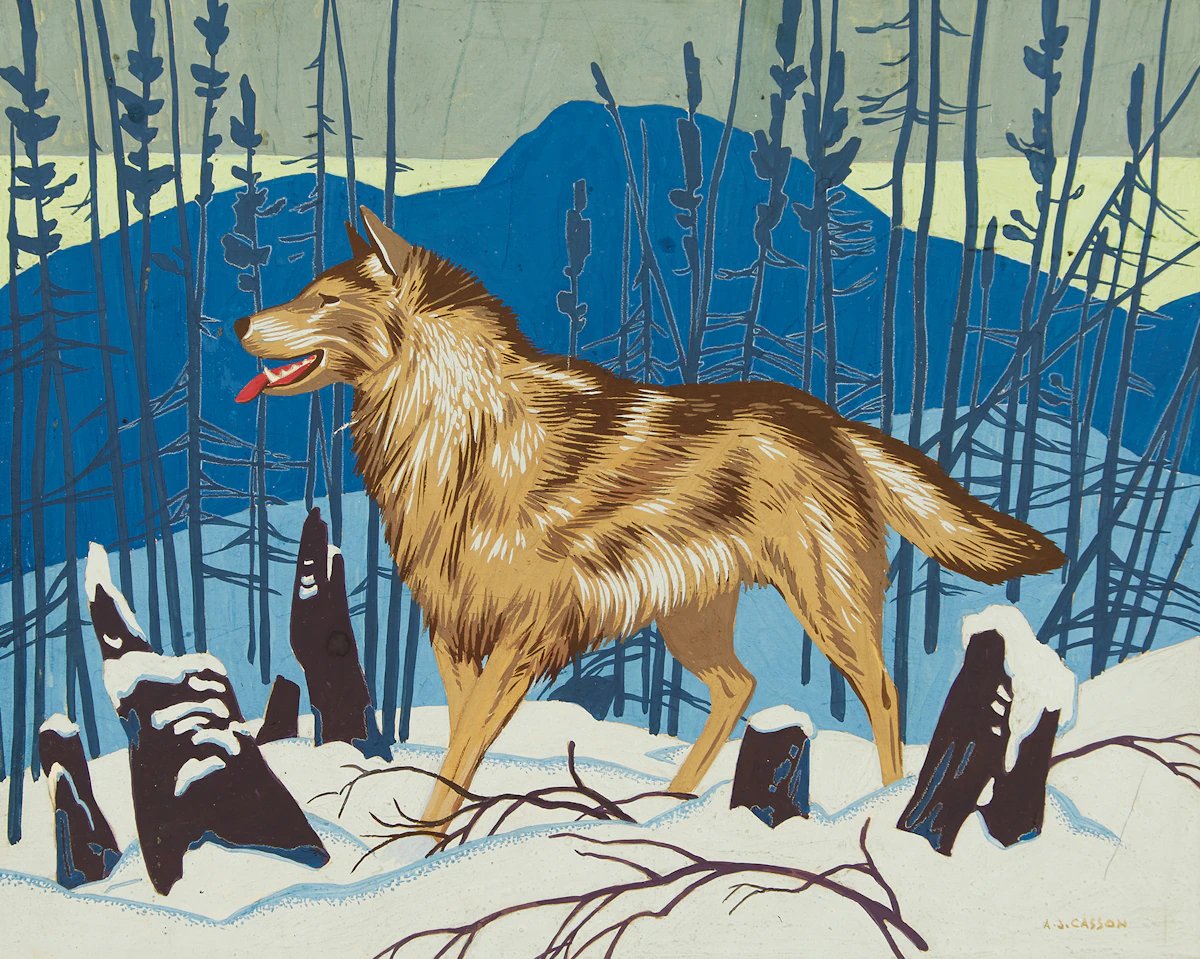
Acquired directly from the Artist
By descent to the current Private Collection, Ontario
Literature
A.J. Casson, “The Possibilities of Silk Screen Reproduction,” Canadian Art, Volume 7, Number 1, 1949, pages 12-14
Casson began his career like many other members of the Group of Seven, as a designer. First apprenticing at the Laidlaw Lithography Company in Hamilton, he later joined Franklin Carmichael at the design firm of Rous and Mann and later accompanied Carmichael to the design firm of Sampson-Matthews. Honing his skills as a silkscreen printmaker at the firm, Casson was lead artist supervisor for the Sampson-Matthews silkscreen productions, a lead artist with the Canadian Malting Company Ltd. and often returned to silkscreen works throughout his own artist career.
For the artist, the silkscreen process was not simply a means to commercially mass produce. Rather, the artist respected the labour-intensive process and was a champion for the medium to be tested and recognized as a distinct and high art form. He argued that its use in commercial art in the 1930s tainted the art form as a respected art practice and maintained that artists should continue to explore the medium's possibilities in fine art.
This work is the original preparatory work for the later-produced silk screen designed especially for the Canadian Malting Company Ltd. Strong supporters of Canada’s wildlife and protecting their environments, the project was initiated by the company to gift silkscreen works of wildlife to the company’s employees and clients. Pin holes, colour testing, and artist’s original inscriptions are all still visible from the artist’s process work within the margins of this original gouache work.
While preparing for the silkscreen process, Casson worked with up to fifteen colours—here in “Wolf in Winter” there are eleven in total. He was careful to select imagery and colours that could easily be reproduced without losing the integrity of the original composition. Forms were simplified but designed so colours could easily be seen at a distance, maintaining strong contrast and vibrancy. Importantly, there is little variation between the artist’s gouache work and the final silkscreen imagery.
As Casson often discarded draft and preparatory works while he was working on commercial projects, it is a rarity to have an original preparatory work for a larger unique body of work from the artist.