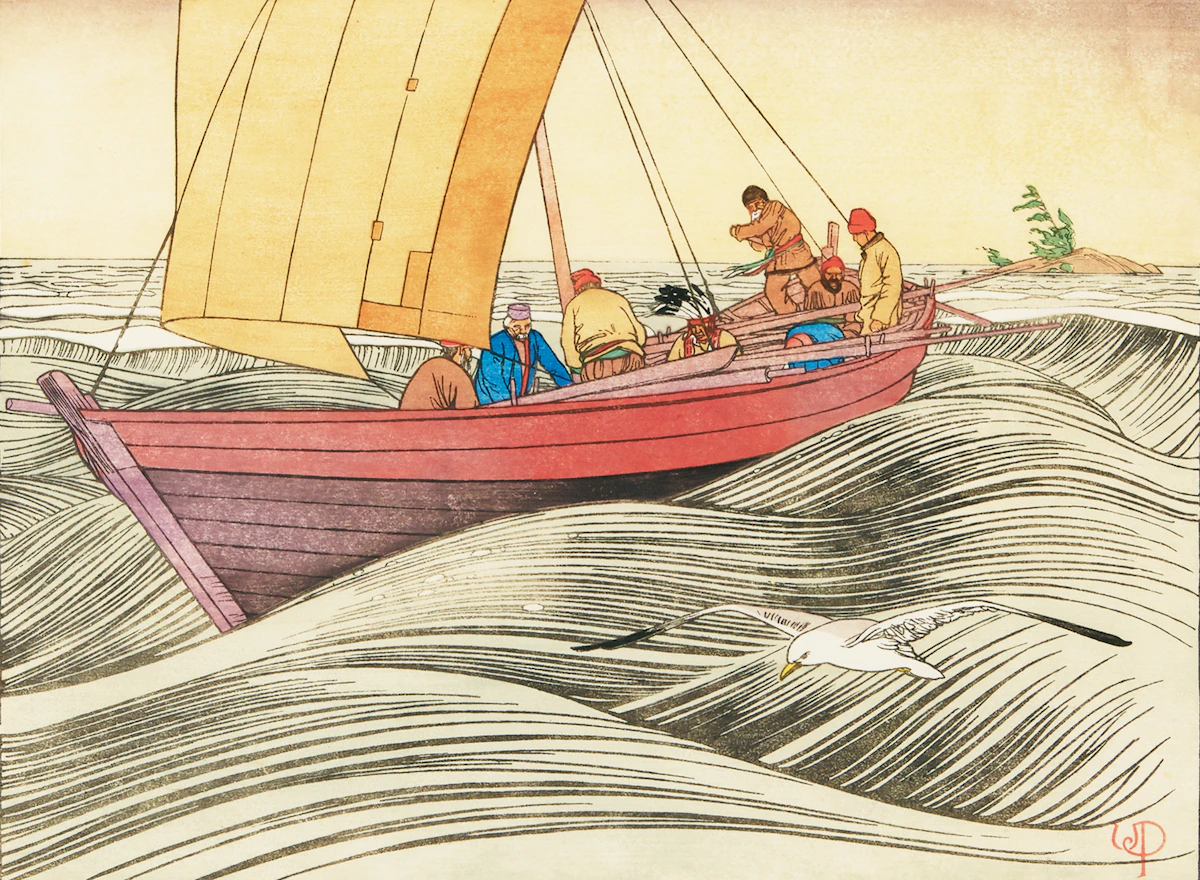
signed, titled and numbered 59/150 in the lower margin
10.25 × 13.75 in (26.0 × 34.9 cm) (image)
Auction Estimate:$15,000 - $20,000
Sale date:November 22, 2016
Price Realized
$19,550
(including Buyer's Premium)
Provenance
Private Collection, Ontario
Literature
Nancy E. Green, Kate Rutherford and Toni Tomlinson, “Walter J. Phillips,” Portland, 2013, pages 27-30, illustrated page 30
Contrary to popular trends of the time, Phillips opted for the pursuit of precision and technical excellence in his artistic practice over the emotional representations of the Canadian landscape. The artist revelled in the technical process of creating works from the initial sketch and designing of the woodblock to producing exacting editions of his carefully constructed images.
Depicting the iconic trading vessel of the Hudson’s Bay Company, the scene is a token of Canada’s trading history. These boats played an integral role transporting goods from inland trading posts to York Factory on the Hudson Bay. “York Boat on Lake Winnipeg” offers a rare instance of emotion in Phillips’s work in comparison to the more picturesque landscape works developed through his traditional art training in Britain. With dramatic arching waves enhanced visually by the curved line-work occupying two thirds of the composition, a sublime portrayal of frustration of the boatmen is captured as they fight the wind and the ebbing tides. Perspective plays an integral role in the work enhancing the sublime in the dramatic scene. Influences of “Japonism” can be seen with the play of perspectives as the seagull in the foreground is disproportionally large to the island in the background. Rather than adhere to the practices of picturesque landscape art where the viewer can enjoy the scene at a safe distance, Phillips positions the viewer in this work as part of the scene looking onto the struggles of the men as the seagull swoops into the foreground near the viewer’s vantage point.
As one of Phillips’ most popular images, this work combines the artist’s technical mastery of the woodcut process and, importantly, the emotional ties to the Canadian landscape by the people occupying the land. Editions of this work are also included in the collections of the National Gallery of Canada, The Glenbow Museum and the Art Gallery of Greater Victoria.