Sara Bowser, “An Interview with Gerald Gladstone,” “The Canadian Architect,” April, 1959, page 72
Denise Leclerc, “The Crisis of Abstraction in Canada: the 1950s,” The National Gallery of Canada, Ottawa, 1992, page 117
Hugo McPherson, “Gladstone: Recent Sculpture at the Isaacs Gallery,” Isaacs Gallery, Toronto, 1961, unpaginated
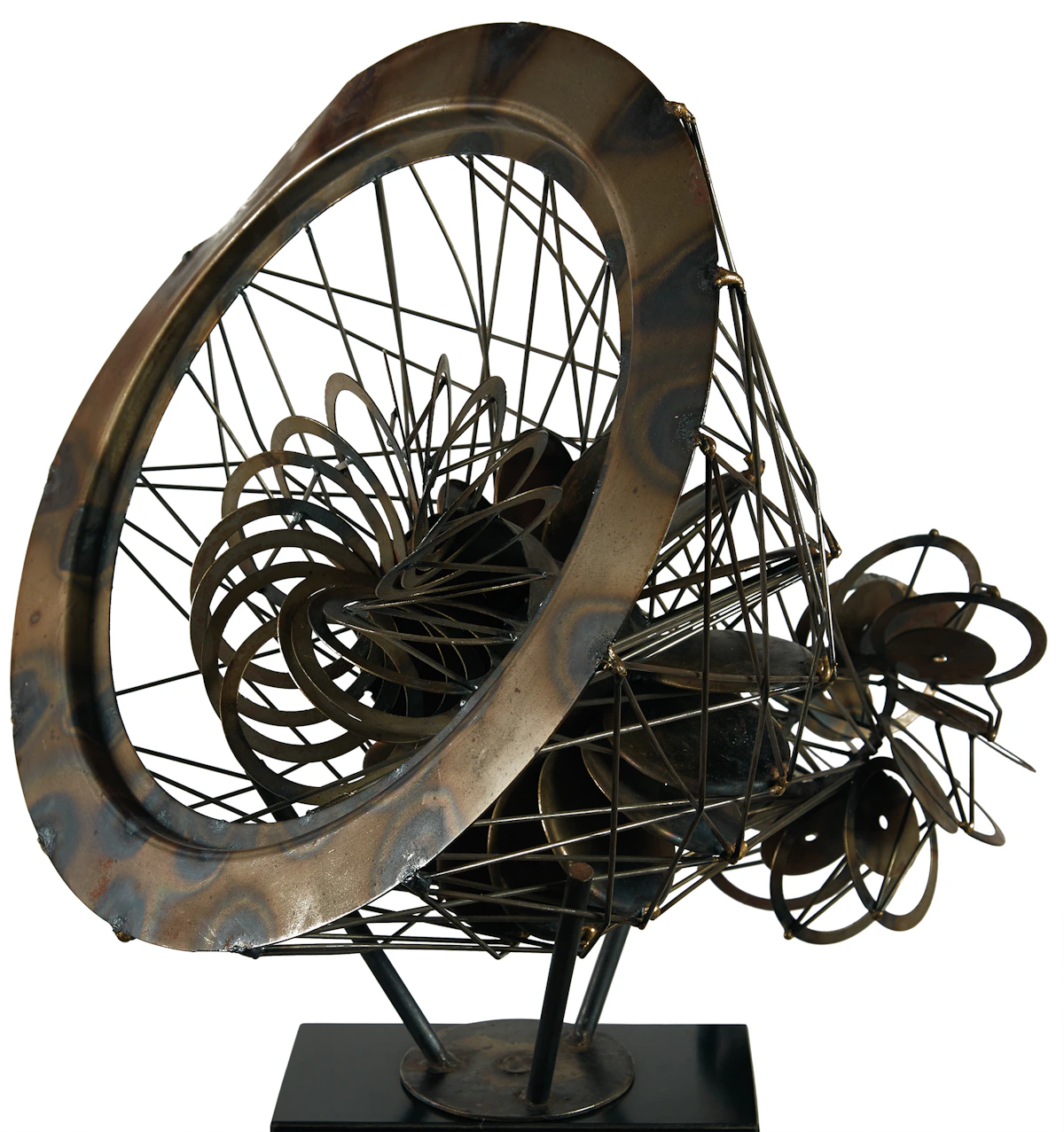
After working in advertising at MacLaren’s Advertising in Toronto, Gladstone changed career paths and began producing welded sculptures. Inspired by Antoine Pevsner and Alexander Calder, the artist recognized their contribution to the rejuvenation in sculpture as a modern process. Rather than work in marble or bronze, Gladstone opted to work with individual pieces of steel, welding the pieces to create whole constructivist sculptures.
Concerned with the interdependency of each piece of metal in relation to the whole composition, there is the suggestion of organic and cellular forms found in nature by the curvature created in his works. In an exhibition catalogue for the artists work at Isaacs Gallery, Hugo McPherson writes that Gladstone’s sculptures “suggest simultaneously the division of cells in the organic chemistry and the birth of galaxies.” There is both a physical and metaphysical relationship at play within his sculptures which explore the infinite and natural order.