Literature
William J. Withrow, Introduction to “Sorel Etrog”, Toronto, 1967, reprinted in “Sorel Etrog: Five Decades”, Art Gallery of Ontario, 2013, page 100, page 59, illustrated (as “Pulcinella”)
“Sorel Etrog: Recent Sculpture”, Dominion Gallery, Montreal, 1967, page 7, illustrated (as “Pulcinella I”)
“Sorel Etrog: Recent Sculpture”, Staempfli, New York, 1968, illustrated, page 20 (as “Pulcinella I”)
Carlo L. Ragghianti, “Sorel Etrog”, Italy, 1968, page 34, illustrated (as “Pulcinella I”)
Sir Philip Hendy, Preface to “Sorel Etrog”, Toronto, 1967, reprinted in “Sorel Etrog: Five Decades”, Art Gallery of Toronto, 2013, page 93
Pierre Restany, “Sorel Etrog”, Munich, 2001, page 90, illustrated (as “Pulcinella II”)
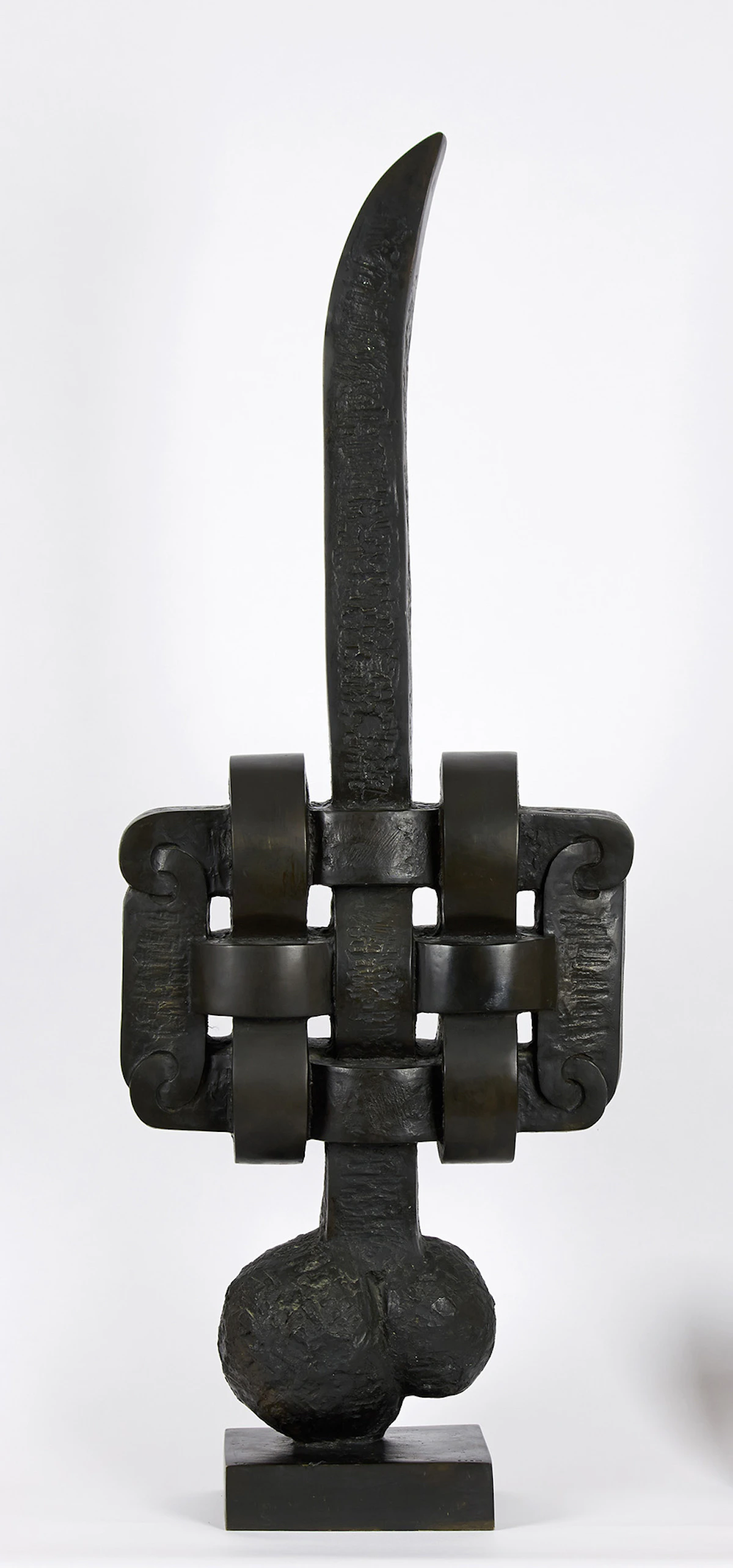
Etrog was chosen to represent Canadian sculpture at the Venice Biennale in 1966. In his Preface to “Sorel Etrog”, Director of the National Gallery in London, Sir Philip Hendy, describes that “of the many spirits which live in [Etrog's] bronzes, the most obvious perhaps is the spirit of metal itself...Etrog understands its substance, its tensions and its surfaces--above all, its tensions.” “Pulcinella I” is a large and powerful work, imbued with a tension of opposing forces. William Withrow characterizes these tensions as “linear and volumetric, geometric and organic, restful and dynamic, sensual and spiritual.”
While works from this series have been exhibited as “Pulcinella” and “Pulcinella I”, the estate of the artist records the bronze as “Pulcinella II”.