Roald Nasgaard, “Abstract Painting in Canada”, Toronto/Vancouver, 2007, pages 287 and 291
Dennis Reid, “A Concise History of Canadian Painting”, Toronto, 2012, page 349
Perehudoff studied at the Colorado Spring Fine Arts Center in Nevada in 1948-49 and at the Ozenfant School of Fine Arts in New York in 1950, where he was “impressed by Ozenfant's Purist-based and idealist insistence on 'significant form’.” This was his foray into the abstract art that he become known for and continually revisited throughout his life. In Saskatoon, abstract art took root in the Emma Lake workshops in the 1960s, with William Perehudoff among its foremost leaders. In 1962, Greenberg came to the Emma Lake workshops and became a strong supporter of Perehudoff. Greenberg “affirmed his belief in the Purist strains of modernism and his belief in the primacy of colour and form as vehicles of aesthetic feeling in painting....” Perehudoff and his wife and fellow painter, Dorothy Knowles, owned a cottage at Emma Lake that allowed them to meet and collaborate with many visiting artists, fueling an international perspective on their artistic practices. “Perehudoff emerged as a painter of more than local ambition in the mid-sixties with big paintings—simple configurations of large rectangles and circles of colour stained into untreated canvas.”
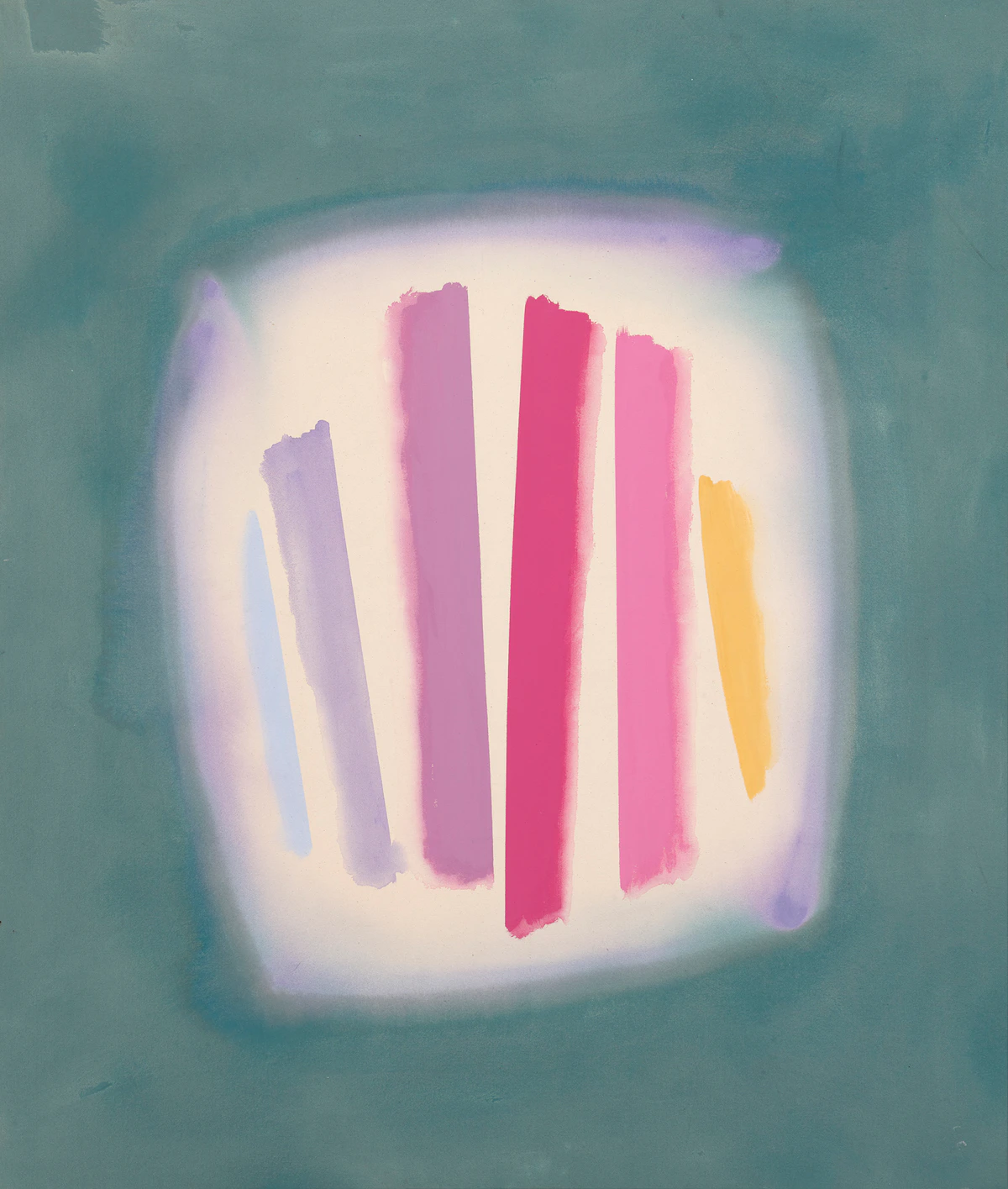
Perehudoff's background as a watercolourist can be seen in the soft hues of greens and purples throughout “AC-88-34”. The long vertical strokes of colour are backlit by a glowing pearlescent white, drawing in the viewer and energizing the space between each stroke of colour.